
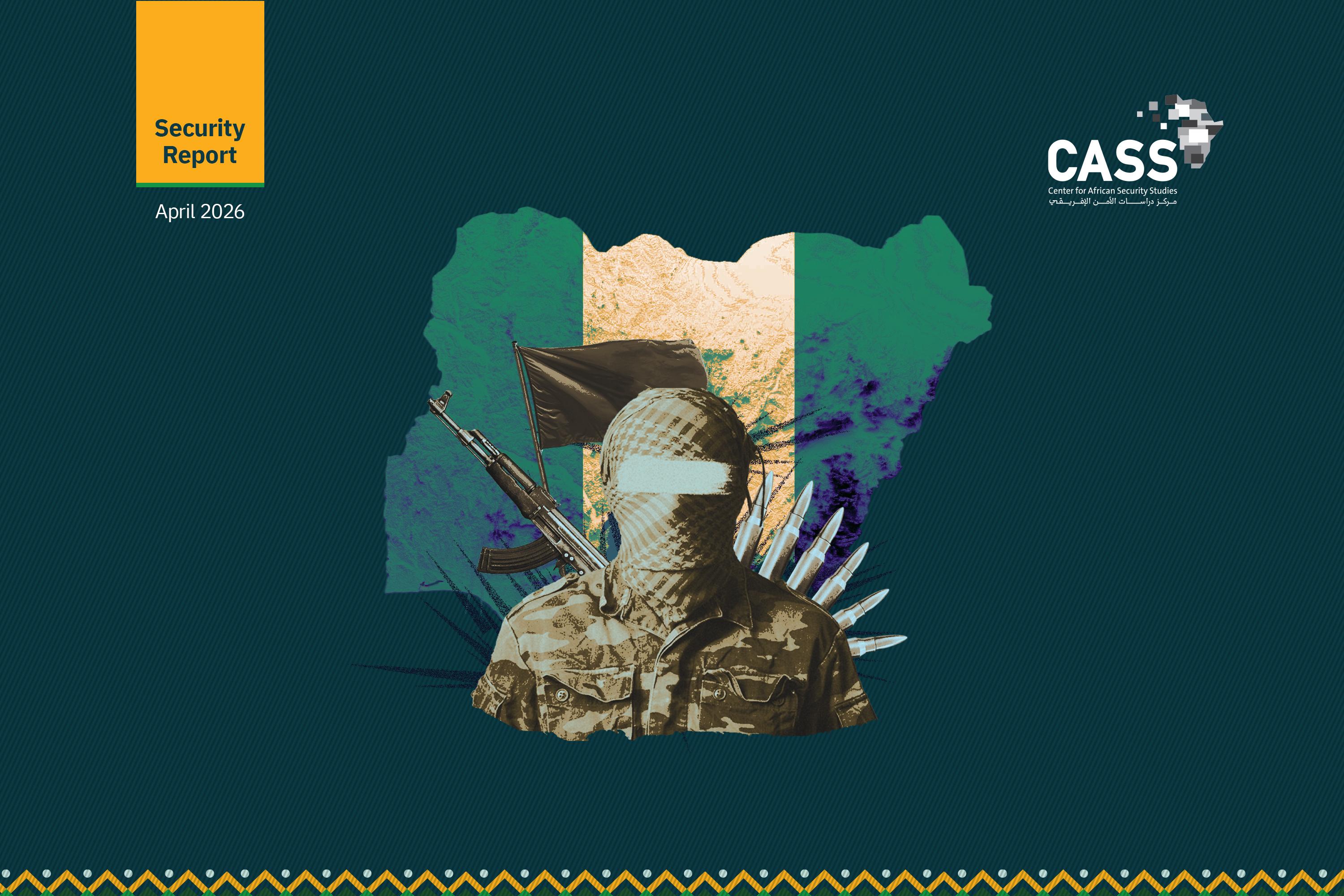
The activity of jihadist groups in Nigeria, primarily Boko Haram and the Islamic State West Africa Province (ISWAP), entered a phase of complex qualitative escalation in April 2026, transcending the traditional pattern of local attacks to approach a multi-level pressure strategy (field – qualitative – strategic).
This escalation reflects shifts in the nature of operations, their geographical spread, and their repercussions on the state and society.
On the field level, the escalation is evident in the increasing frequency and diversity of operations. Northeastern Nigeria, particularly Borno State, witnessed simultaneous attacks carried out by both groups, including complex assaults on cities such as Maiduguri, reflecting a capacity for operational coordination and an increased level of boldness.
Deadly attacks were also recorded in other states such as Niger and Zamfara, indicating the expansion of the scope of activity beyond traditional insurgency strongholds. Furthermore, a return to the pattern of mass attacks on villages and local infrastructure is noted, reproducing scenes of widespread violence that prevailed at the peak of the insurgency previously.
In contrast, the Nigerian military intensified its air and ground operations, increasingly relying on precision airstrikes against sites suspected of being logistical centers for armed groups. However, the Nigerian Air Force's bombing of the Gelle market on April 11, which resulted in the deaths of dozens or hundreds of civilians, revealed deep issues in intelligence accuracy and target discrimination, and drew sharp criticism regarding the human cost of these operations.
These incidents indicate that the current military approach, despite its intensity, may contribute to fueling an environment of local resentment that armed groups exploit for recruitment and propaganda.
Three main levels can be identified. First, on the security level, the escalation has raised the threat level to a broader national scope, as attacks are no longer confined to the northeast but have begun to gradually extend toward the center and even threaten the capital.
Second, on the political level, this escalation places the government under increasing pressure, especially in light of recurring intelligence failures and incidents affecting civilians.
Third, on the social level, the continued violence reinforces the state of instability and deepens the displacement crisis and the lack of trust between the population and the state.
There is an even more dangerous development represented by the strengthening of coordination between regional jihadist branches, where communication is possible between ISIS in West Africa and its counterpart in the Sahel, potentially opening the door for broader networks of financing and operational planning. This factor reinforces the trans-border nature of the threat and increases the complexity of confronting it.
In light of these data, three main scenarios can be drawn for the coming months. The first scenario is the continuation of disciplined escalation, where groups continue to carry out qualitative attacks without reaching wide control over territories, in exchange for the continuation of government military operations. This is the most likely scenario.
The second scenario consists of a major qualitative escalation through the execution of a successful attack on a strategic target (such as an airport or a sovereign facility), which could lead to a shift in the threat level and undermine trust in the state. As for the third scenario, which is the least likely, it is based on a gradual containment of the escalation in the event of improved intelligence coordination and the reduction of operational errors.
Overall, Nigeria appears poised to face a more complex stage of conflict, moving beyond traditional containment toward deeper structural challenges.